

Is Binance Still Safe in 2026? Bybit vs KuCoin Security Comparison
Is Binance still safe in 2026? Compare Bybit vs KuCoin security, fees, risks, and features to find the safest crypto exchange today.
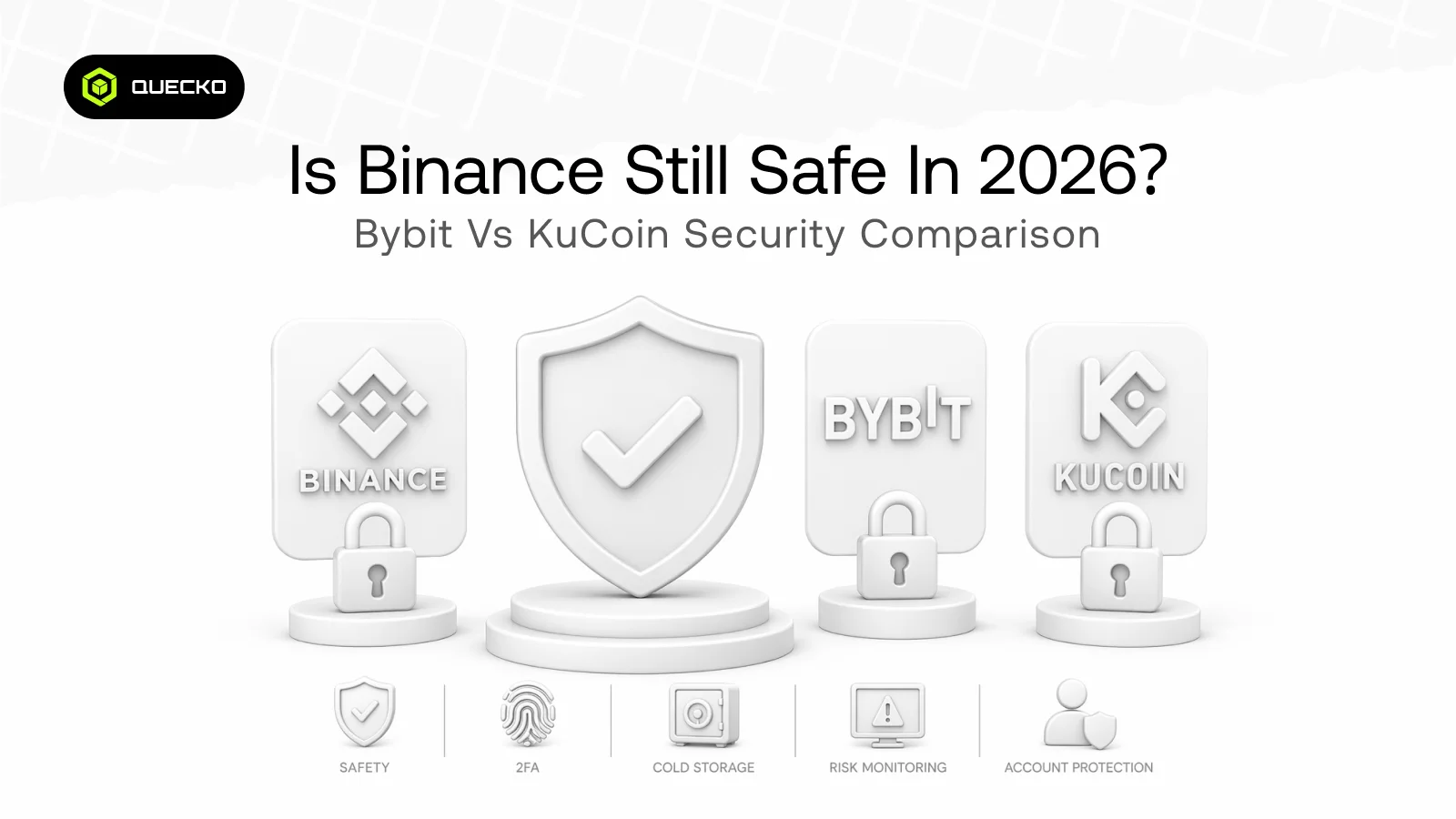
Most traders today are asking the same thing:
- Is Binance still the safest crypto exchange?
- Can Bybit be trusted for long-term trading?
- Is KuCoin safe after past exchange hacks?
And honestly, these are fair questions. If you’re still wondering which crypto exchange is safe in 2026… you’re not alone.
Because in 2026, a crypto exchange is no longer just a trading app; it’s where your entire digital portfolio is. Many users now also use a hardware wallet for added security, in addition to exchanges. This is why many traders combine exchange usage with a personal crypto wallet for better control over their assets.
Rising cyber risks and what traders should know
And with cyber risks rising globally, the stakes are higher than ever.
According to Statista forecasts, global cybercrime costs are expected to reach around $11.36 trillion in 2026, rising from $9.22 trillion in 2024. That’s not just a number; it shows how fast digital threats are growing across financial systems, including crypto exchanges.
Modern crypto exchanges are investing more in infrastructure and protection systems than ever before
That’s why people now care more about:
- security systems
- regulatory compliance
- custody methods
- and real transparency
In Europe, MiCA regulation is becoming a key framework for all major crypto exchanges. Binance is also aligning with MiCA regulation to maintain its regulatory presence. Another growing factor is whether exchanges hold proper regulatory licenses in different jurisdictions.
How do these crypto exchanges actually compare?
Let’s break it down simply, What are we really looking at here?
Binance → largest crypto exchange, strong ecosystem
Bybit → fast-growing crypto exchange focused on traders.
Platforms are expanding features with a growing copy trading ecosystem. Some users compare features with platforms like Coinbase One, especially when evaluating subscription-based benefits and protections.
KuCoin → altcoin-heavy crypto exchange with widely supported coins.
Does popularity really mean safety?
But here’s the real question. Does popularity actually mean safety?
Not really. Different crypto exchanges operate under different risk models and security standards. Apart from small competitors, every Binance Review in the present highlights how its scale and infrastructure are its main distinguishing factors.
Is Binance still the safest crypto exchange in 2026?
This is the big question everyone wants answered.
So let’s talk about it.
Binance is still the largest crypto exchange in the world, especially for spot trading. It has the deepest order book, which means trades execute quickly even in volatile markets using market orders. It also offers strong trading capabilities across different markets and user levels.
Key security systems that protect Binance users
What actually keeps Binance safe?
Well, a few things:
It uses two-factor authentication for account protection.
It also supports advanced protections like IP whitelisting, allowing users to restrict account access to trusted devices and locations and biometric login on mobile. For advanced users managing large accounts, IP whitelisting ensures that only approved devices can access trading accounts, reducing unauthorized login risk. Another layer of protection is IP whitelisting, which further locks account access to trusted devices only.
Most user funds are stored in Cold Wallets and advanced cold storage systems.
Binance also relies heavily on layered cold storage systems to protect user assets across different regions. Analysts also evaluate exchange safety using cold storage ratios.
This extended cold storage approach helps reduce exposure to online threats.
A large portion of reserves is kept in cold storage, which is one of the key reasons users trust the platform.
It has improved transparency through proof of reserves disclosures.
Binance continues expanding its reporting standards, and regular proof of reserves updates help users independently verify the platform’s solvency and trust its financial backing.
It has strong insurance coverage systems that reduce custodial risk.
Binance operates with the support of a diverse range of regulatory licenses worldwide, which helps build its trustworthiness among users.
Binance has further improved its security protocols in general, particularly in response to the security breaches and scandals that the entire industry has faced over time.
It also follows improving regulatory compliance standards and maintains a strong regulatory status in multiple regions.
Now, yes, Binance has faced exchange hacks in the past. But the key thing is how it responded and rebuilt its systems afterwards.
Trading Ecosystem inside Binance Explained
Today, Binance is still the most complete ecosystem for:
spot trading
margin trading
futures
API access for automation
Many users also test small withdrawals through test transactions before moving larger funds, adding an extra safety layer. It also gives sophisticated trade instruments to novices as well as experts.
And when it comes to cost, Binance is also competitive with lower taker fees, optimized withdrawal fees, and tier-based discounts through VIP tiers.
In simple terms, Binance is still the most balanced mix of safety, liquidity, and usability in 2026. Advanced traders often keep long-term funds in a separate hardware wallet.
This is largely because it offers a smoother overall trading experience compared to most competitors.
What about Bybit? Is it safer than Binance?
So where does Bybit stand in all of this?
Backed by this rise, Bybit is bringing new features to users all the time. Starting with a smaller group of margin and derivatives traders, it has been rapidly expanding its user base. Like other larger crypto exchanges, it is still upgrading its infrastructure so that it can continue competing on a worldwide basis.
If you use Bybit, you’ll notice:
- very fast execution in spot trading
- strong liquidity in its order book
- support for API access and algorithmic trading
- structured market orders system
It also provides advanced trading tools for active traders and automation strategies.
Security-wise, Bybit uses two-factor authentication and publishes regular reserve reports.
It also performs proof-of-reserves audits, which helps build trust and supports better regulatory compliance positioning.
It also includes limited insurance coverage compared to Binance.
But here’s the reality:
Bybit is strong, but still younger than Binance.
It hasn’t faced major exchange hacks recently, but it doesn’t yet have the same global trust depth or ecosystem scale.
So it’s safe, but not as battle-tested as Binance.
KuCoin? Is it still reliable?
Now let’s talk about KuCoin.
KuCoin is more of a “high-risk, high-reward” exchange. Among emerging crypto exchanges, it remains popular for early access to new tokens. Some users also explore tools like DEX aggregators to find better prices outside centralized exchanges.
People use it mainly for:
- early spot trading opportunities
- smaller altcoins
- flexible trading access
But here’s where things get more balanced.
KuCoin has:
- variable withdrawal fees depending on the network
- Weaker transparency compared to Binance
- history of exchange hacks in earlier years
- moderate custodial risk
It is also affected by fluctuating gas fees across blockchain networks, which can increase costs for users.
During congestion, gas fees can significantly impact withdrawals and transfers.
It still offers:
- margin trading
- spot trading access
- VIP tiers for active users
- API access for advanced trading
But overall, it’s less trusted for long-term storage and has a weaker regulatory status compared to Binance.
KuCoin is more for opportunity trading, not long-term safety.
What is the comparison of their real trading usage?
Let’s simplify this part.
Spot trading → Binance clearly dominates here
Margin trading → Bybit leads
Market orders → Binance and Bybit both execute quickly
API access → Both strong for automation
Each of these features eases daily trading not only for newcomers but also for experienced traders.
Fees:
Binance → lower taker fees + reduced spot trading fees
Bybit → balanced structure
KuCoin → fluctuating withdrawal fees dependent on network gas fees
Down to earth, lower taker fees make a big difference if you trade a lot. In fact, it changes your total earnings without most people realizing it.
Hidden cost factors traders often ignore
Here’s something most traders overlook; how do maker/taker rates actually affect your trades in real time? Because, depending on whether you’re adding liquidity or taking it, your costs can quietly change without you even noticing. People who don’t always think about regional availability can actually decide which exchange you can even use in the first place, depending on where you live.
But here’s a question many traders don’t ask enough. Are you really aware of it? Crypto trading fees, or are you just looking at surface-level numbers? Because sometimes what looks cheap at first can turn into hidden fee traps over time. Traders often overlook how smoothly your orders actually execute, especially during high volatility and liquidity issues.
Market execution, liquidity, and real trading performance
On top of that, Binance still leads in the spot market, especially when it comes to liquidity and execution speed.
When it comes to spot trading fees, even small differences can add up over time, especially for active traders.
And honestly, whether you’re buying and selling, execution speed + fees together make a noticeable difference in real trading conditions.
Advanced trading strategies and user behavior
Some users also explore liquidity mining, especially on platforms that offer yield-based incentives for providing liquidity while trading or holding assets.
On top of that, strong trading tools across Binance and Bybit also play a huge role, especially when you’re managing fast entries and exits in volatile markets.
Also, for users exploring altcoin trading, KuCoin often stands out because it gives access to a much wider range of smaller and early-stage tokens compared to other exchanges.
And one more thing, people are starting to worry about 2026, regulatory uncertainty. Because, depending on where you live, exchange access and features can suddenly change without much warning.
Are there still risks in 2026?
Yes, and this is important.
Even the safest exchanges are not risk-free. All centralized crypto exchanges still carry some level of custodial and operational risk.
- Custodial risk still exists (you don’t own private keys)
- Exchange hacks remain a global threat.
- Withdrawal fees vary during congestion.
- Regulations can affect access and regulatory compliance environments.
- Users still face general market risks during volatility cycles and bear market conditions.
Past security breaches across the industry have shown that no platform is completely immune, which is why exchanges continue improving their security measures over time. That’s why security is no longer just about features; it’s about trust history.
What are people actually saying on Reddit?
If you look at real Reddit discussions, the sentiment is actually quite clear:
- Binance is seen as the safest all-in-one exchange for spot trading and long-term use.
- Bybit is preferred by active traders focused on margin trading and speed.
- KuCoin is seen as risky but useful for early spot trading opportunities.
The interesting part?
Even critical users still trust Binance more than others overall.
That says a lot about long-term confidence in a crypto exchange.
Crypto Exchange Security Comparison (2026 Overview)
| Exchange | Past Security Incidents | Key Security Features | Risk Profile (2026 view) |
| Binance | 2022 BNB Chain exploit (~$570M bridge attack, not core exchange breach) | SAFU fund, 2FA, cold storage, real-time risk monitoring | Low–Medium
(very strong security, but the highest global target) |
| Bybit | No major exchange-wide breaches reported | Cold storage, multi-signature wallets, and advanced risk controls | Low
(strong operational security, smaller attack surface) |
| KuCoin | 2020 hack (~$280M, majority recovered) | Insurance fund, upgraded security systems, improved monitoring | Medium
(improved, but past incident history remains relevant) |
Final Safety Verdict Layer (Decision View)
Final answer:
Binance is still the safest crypto exchange in 2026.
Not because it’s perfect, but because it has the strongest mix of:
- security features
- liquidity
- Cold Wallet storage and advanced cold storage infrastructure
- proof of reserves audits
- and long-term resilience
It has also reduced risks through better infrastructure and continuous system upgrades.
Quecko’s Role in Crypto Exchange Security in 2026
Quecko helps improve the safety behind modern crypto exchanges. It works on things like secure smart contracts, wallet systems, and backend infrastructure that reduce risks like hacks and fund mismanagement.
As security becomes more important in 2026, companies like Quecko are quietly powering the systems that make exchanges safer and more reliable for users.
Conclusion
In 2026, it’s less about finding a “perfect” crypto exchange and more about finding the one that fits how you trade and the risk you’re okay with.
Binance still leads in balance, liquidity, and security. Bybit suits active traders who want speed and strong tools. KuCoin works for altcoin opportunities, but with higher risk.
At the end of the day, no exchange is fully risk-free. The real difference is how each one manages that risk.
So the better question is simple: which exchange actually fits your trading style?
FAQ.
1. Do I need more than one crypto exchange in 2026?
Not always, but many traders use more than one to balance fees, features, and access to different coins. It really depends on your trading style.
2. What’s the safest way to store crypto from exchanges?
For long-term holding, many users move funds to a hardware wallet so they control their private keys instead of keeping everything on an exchange.
3. How does Quecko help crypto exchanges stay secure?
Quecko builds secure blockchain systems and tools that help exchanges reduce risks, protect user funds, and improve overall platform reliability.
4. Which crypto exchange is best overall in 2026?
Binance is the best overall due to the balance of safety, liquidity, and ecosystem strength.
Author

Khola Abbasi
No description availableDate
3 days agoShare on
Related Blogs
The Post-Quantum Wallet: Why Lattice-Based Security is the New Standard
2 hours ago
Bitcoin Above $73,000 Despite a Global War: Is Crypto Becoming the New Safe Haven?
2 hours ago
How Exchanges Make Billions Using USDT Trading Pairs
3 days ago
Is Binance Still Safe in 2026? Bybit vs KuCoin Security Comparison
3 days ago








 +971-50-740-0268