

Perpetualization vs. Tokenization: Which Path for Real-World Assets?
Explore tokenization vs perpetualization for RWAs. Learn which model delivers ownership, liquidity, and scalable Web3 growth.
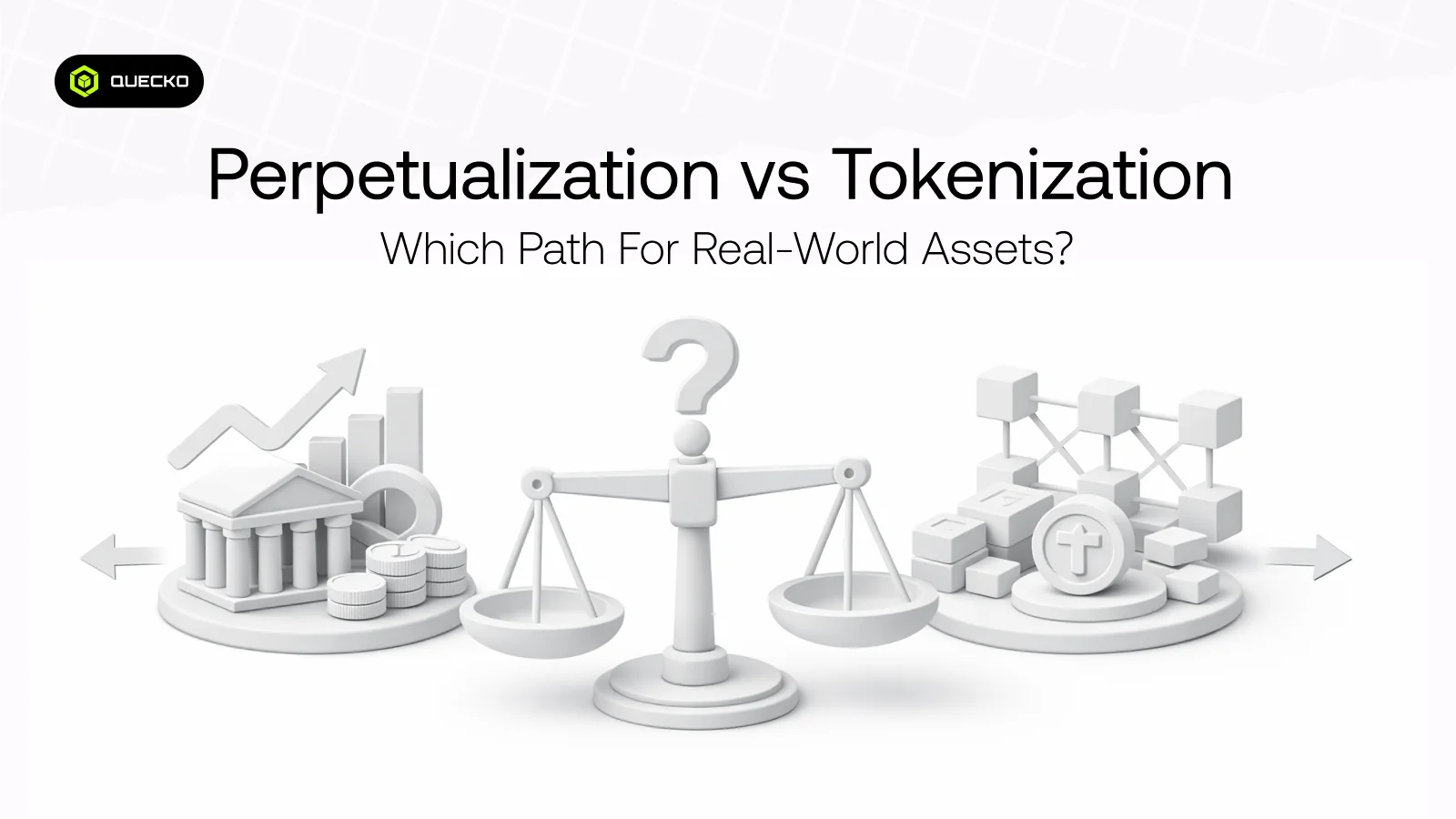
Real-World Assets (RWAs) are rapidly becoming one of the most transformative sectors in Web3. From real estate and commodities to private credit and invoices, the shift toward bringing off-chain value on-chain is no longer experimental, it’s strategic.
But as founders and institutions move into the RWA space, a critical question emerges:
Should you tokenize the asset, or create perpetual exposure to it?
At Quecko, we work with Web3 startups and enterprises navigating this exact decision. Both models unlock opportunity. Both come with trade-offs. And choosing the right path depends entirely on your product vision. Let’s break it down.
Tokenization: Ownership on the Blockchain
Tokenization is the process of converting real-world assets into blockchain-based digital representations. These tokens can represent fractional ownership, debt instruments, revenue rights, or yield-bearing claims.
This model fundamentally transforms how assets are accessed and traded.
By moving assets on-chain, tokenization unlocks:
- Fractional ownership for global investors
- Increased liquidity for traditionally illiquid markets
- Transparent settlement and programmable compliance
- Integration with DeFi ecosystems
Tokenization is particularly powerful for long-term investment products. It enables real ownership, enforceable rights, and potential yield distribution. For institutional-grade platforms, it provides the legal and structural backbone needed for sustainable RWA adoption.
However, tokenization comes with complexity. Regulatory compliance varies by jurisdiction. Legal structuring must be airtight. Custody, asset servicing, and KYC requirements add operational layers that cannot be ignored.
In short, tokenization is powerful, but it requires serious infrastructure and regulatory planning.
Perpetualization: Exposure Without Ownership
Perpetualization takes a different approach.
Instead of tokenizing the asset itself, platforms create perpetual, tradable markets that track the asset’s price. Users gain exposure to the value movement of a real-world asset without holding it directly.
Think of it as bringing RWA price discovery into a crypto-native trading environment.
This model offers significant advantages:
- Faster time to market
- No need for asset custody
- Simplified legal structure
- Capital-efficient liquidity
- Global access for traders
Perpetualized RWAs are ideal for speculation, hedging, and short-term strategies. They appeal to active traders and platforms building derivatives, prediction markets, or synthetic financial products. The trade-off is clear: users do not gain legal ownership or direct rights to cash flows. They gain price exposure only.
For many platforms, especially those focused on trading velocity and market liquidity, that is more than enough.
Strategic Differences That Matter
Tokenization is ownership-driven. It prioritizes long-term capital formation and real-world integration. Perpetualization is liquidity-driven. It prioritizes market efficiency, leverage, and access.
Tokenization requires compliance-heavy architecture but creates sustainable financial rails. Perpetualization reduces operational friction but centers on synthetic exposure. One model builds the bridge to traditional finance. The other builds high-speed highways for traders.
Neither is universally better. The right choice depends on who your users are and what economic behavior you want to enable.
When to Choose Tokenization
Tokenization is the stronger path if your goal is to:
- Offer real ownership or yield-bearing instruments
- Attract long-term investors
- Build institutional-grade RWA infrastructure
- Create compliant, asset-backed financial products
It is ideal for platforms focused on capital formation, asset issuance, and structured real-world finance.
When to Choose Perpetualization
Perpetualization makes more sense if your product vision centers on:
- Trading and derivatives
- Global liquidity access
- Faster deployment cycles
- Capital-efficient exposure models
It is especially effective for exchanges, synthetic markets, and DeFi-native trading platforms that want to integrate real-world price feeds without custody complexity.
The Hybrid Future of RWAs
The most forward-thinking ecosystems won’t choose just one. They will combine both.
Tokenized RWAs can serve as the foundational ownership layer, while perpetual markets provide liquidity, hedging tools, and price discovery. Together, they create a powerful financial stack, real assets underneath, dynamic liquidity on top.
This hybrid approach enables capital formation and trading efficiency to coexist. That’s where the future of RWAs is headed.
How Quecko Helps You Build the Right Model
At Quecko, we help founders design and deploy RWA platforms tailored to their strategy.
Whether you’re building:
- A fully compliant tokenization platform
- Synthetic RWA perpetual markets
- Hybrid ownership-plus-liquidity ecosystems
- DeFi-integrated RWA infrastructure
Our team supports smart contract architecture, backend engineering, UI/UX design, and Web3 go-to-market strategy.
We don’t just build products, we help define the economic model behind them.
Final Thoughts
Real-world assets are not a trend. They are the next structural layer of Web3 finance.
The question isn’t whether RWAs will scale, it’s how they will be architected. Tokenization brings ownership on-chain and perpetualization brings liquidity on-chain.
The smartest builders understand both, and design accordingly. If you’re building in RWAs and evaluating your path forward, this is the moment to make the right architectural decision.
And when you’re ready to build it right, Quecko is here to help.
Author

Fatima Ahmed
Blockchain Writer & Web3 ExpertI am a content writer with a passion for creating engaging content. I aim to simplify complex topics for readers through writing. With a keen interest in blockchain and crypto, I strive to foster understanding and empower readers to explore new ideas!

Date
1 minute agoShare on

Related Blogs
Perpetualization vs. Tokenization: Which Path for Real-World Assets?
1 minute ago
Post-Quantum Blockchain Security: How Crypto Is Preparing for Quantum
5 days ago
Why 2026 Is Web3’s Moment?
6 days ago
Real-World Use Cases of Blockchain Beyond Cryptocurrency
6 days ago








 +971-50-740-0268