

The Future of Decentralized Social Networks: Beyond Web2 Platforms
Discover the future of decentralized social networks and how blockchain-based platforms empower users, creators, and communities beyond traditional Web2 social media.
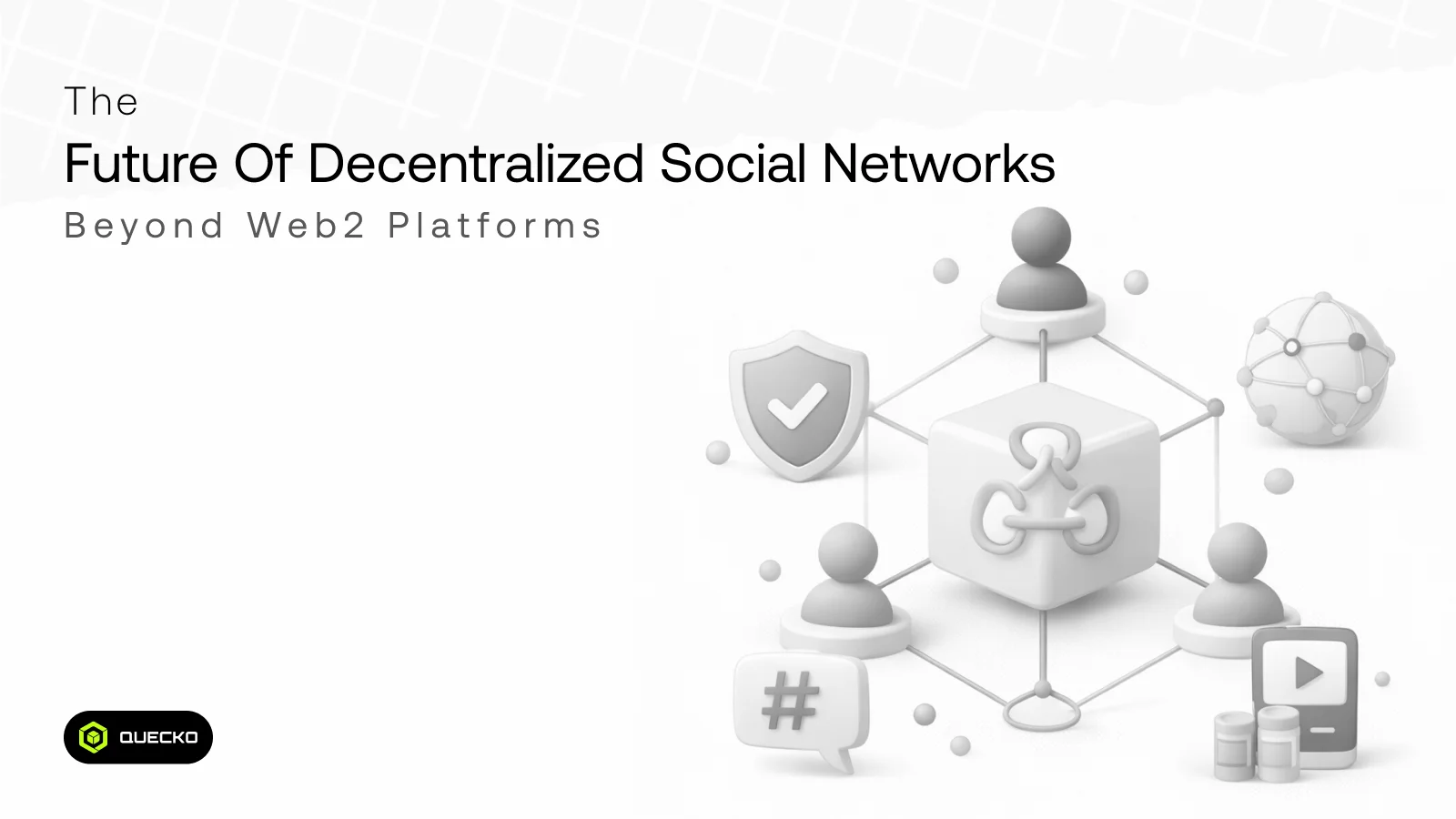
Social media has transformed how individuals communicate, share ideas, and create online communities. The platforms that dominate the social networking market include X, Instagram, Meta, and TikTok, which dictate culture, politics, and the creator economy. Nevertheless, there are structural weaknesses in Web2 social media platforms that stem from centralization.
As data privacy, user control, content monetization, and platform control increase, another alternative is emerging: decentralized social networks. These platforms are based on blockchain technology, smart contracts, and a decentralized structure, and will bring social media out of the constraints of Web2 and into a user-owned internet.
Why Web2 Social Media Is Reaching Its Limits
Web2 social media networks are centralized service providers. They contain user-generated content, regulate algorithms, handle user data, and determine monetization policies. Although this model provides a way to scale and a pleasant user experience, it also produces systemic problems:
- Users do not truly own their digital assets or content
- Platforms monetize user data without meaningful consent
- Content creators depend on opaque algorithms for visibility
- Content moderation decisions lack transparency and appeal mechanisms
- Accounts can be suspended, restricted, or demonetized instantly
The lack of control over the users is indicated by problems such as access denied messages, bizarre connection problems, shadow bans, or no specific error reference number. The power imbalance between the platforms and users is evident even in technical aspects such as IP address tracking and restrictions on requested URLs.
These constraints have led to a call for decentralized alternatives that prioritize user empowerment and digital sovereignty.
What Are Decentralized Social Networks?
Decentralized social networks are social media systems that run on blockchain networks rather than centralized servers. Instead of a single company owning user data and social graphs, ownership is distributed across users and protocols.
Key principles include:
- User-owned content stored via decentralized storage
- Decentralized identity rather than platform-controlled accounts
- On-chain posts and interactions secured by cryptographic technology
- Community governance instead of corporate decision-making
These networks enable users to interact directly, without intermediaries, through decentralized applications (dApps) built on open protocols rather than closed platforms.
The Role of Blockchain Technology and Smart Contracts
Blockchain technology underpins decentralized social networks. Every interaction, posting content, liking, following, tipping, or monetizing, is recorded on-chain or cryptographically verified.
Smart contracts automate platform logic, including:
- Tokenized rewards for creators and contributors
- Content monetization rules
- DAO voting and decentralized governance
- Revenue distribution without intermediaries
Since smart contracts can be verified and transparent, they reduce the need for trust, minimise technical difficulties, and eliminate the ad hoc rule changes typical of Web2 environments.
Digital Identity
Web2 links digital identity to centralized databases, emails, phone numbers, and platform-controlled credentials. Identity on decentralized social media is portable.
Cryptographic techniques, Zero-Knowledge Proofs, and decentralized identification systems help customers reveal their identities without revealing personal statistics. Tools like Ray ID make it feasible to authenticate on decentralized social networks without compromising data privacy.
This shift allows users to have greater manipulate over their recognition, followers, and social graph, without relying on a selected platform.
Content Moderation and Decentralized Justice
One of the maximum difficult problems of decentralized social networks is content moderation. In the absence of centralized power, the platforms should strike a balance between free speech and community protection and norms.
Decentralized governance models introduce alternatives:
- DAO-based moderation policies
- Community voting on moderation rules
- Content curation DAOs that rank and surface content
- Decentralized justice systems like Kleros arbitration
These systems allow disputes to be resolved transparently rather than through opaque corporate decisions, increasing fairness and accountability.
Leading Protocols Driving Decentralized Social Media
Leading protocols are laying the groundwork for decentralized social media by replacing centralized structures with open, blockchain-based social infrastructure owned and governed by customers.
Lens Protocol and Farcaster Protocol
Lens Protocol and Farcaster Protocol constitute a major shift towards protocol-primarily based social networking. Instead of locking users into a single app, they enable an interoperable social layer in which profiles, followers, and content can flow freely across decentralized platforms.
This creates an NFT-based social graph that users surely own, enabling innovation without permission from centralized systems.
DeSo Blockchain and Specialized Social Chains
DeSo is a social blockchain designed to scale for on-chain posts, interactions, and monetization. It is optimized for social use cases, unlike general-purpose blockchains.
In the meantime, blockchains like Base Chain (Layer 2) enhance the cost-effectiveness and scalability. Layer 2 scaling and Layer 2 blockchains are necessary to enable high-speed, low-cost, global social interactions.
Redefining the Creator Economy
Decentralized social networks fundamentally transform the creator economy. Instead of relying on ads and sponsorships controlled by platforms, creators can monetize directly through:
- Social tokens representing community participation
- Tokenized rewards for engagement and loyalty
- NFT-based memberships and Digital Art ownership
- Token-Based Incentives aligned with long-term value
Experiments like Friend. Tech tokens and NFT-driven interactions show how creators can build sustainable, user-aligned economies without intermediaries.
DeFi Meets Social Media
Some decentralized social networks integrate decentralized finance features, creating new economic layers within social platforms. These include:
- Liquidity pools tied to social tokens
- Yield farming mechanisms for active users
- Decentralized lending backed by digital assets
- Prediction markets driven by community sentiment
This convergence allows users to earn from participation, not just content creation, blurring the line between social media and financial systems.
Virtual Worlds, NFTs, and Social Experiences
Social networks are becoming increasingly decentralized, incorporating virtual worlds and immersive environments. Based on on-chain games, such as Axie Infinity, they combine social interaction, gambling, and economy.
Virtual Real Estate, NFT avatars, and digital identities become social spaces with rules that exist in a decentralized form. Other platforms, such as Theta Network, also examine decentralized content delivery to serve socially focused applications that consume large amounts of video.
Security, Audits, and Trust
In decentralized social media, security is vital. Regular security audits are required to prevent exploits that could compromise user funds and information stored in smart contracts.
Although decentralization decreases the existence of single points of failure, it also creates new risks. Effective cryptography, open governance, and unrelenting auditing are critical to building trust and user adoption in the long term.
Challenges to Mass Adoption
Despite rapid innovation, decentralized social networks face real obstacles:
- Complex onboarding for non-crypto users
- Wallet management and key security
- Scalability constraints on blockchain networks
- Regulatory uncertainties across jurisdictions
- Balancing decentralization with a smooth user experience
Solving these challenges is essential for moving decentralized social media from niche communities to mainstream adoption.
The Future
Interoperability protocols, better decentralized architecture, and user-friendly design are the long-term prospects of decentralized social networks. With the maturity of platforms, users will desire smooth experiences without losing control.
Digital sovereignty, the actual possession of identity, content, and social networks, will be a principle of the next-generation social media.
With Web3 influencers, builders, and communities continuing to experiment, decentralized social networks are becoming a viable alternative to Web2.
Conclusion
The decentralized social networks are not just a technological upgrade but a change in philosophy in the way the internet works. These channels undermine the values of Web2 social media by incorporating blockchain technology, smart contracts, decentralized control, and user-owned content.
Social networking can change when decentralized social networks are used, empowering users and making the digital future more just, more transparent, and even more resilient, given current trends in adoption and infrastructure development.
Author

Fatima Ahmed
Blockchain Writer & Web3 ExpertI am a content writer with a passion for creating engaging content. I aim to simplify complex topics for readers through writing. With a keen interest in blockchain and crypto, I strive to foster understanding and empower readers to explore new ideas!

Date
2 months agoShare on

Related Blogs
How to Evaluate Crypto Project Legitimacy: The Investor’s Checklist
7 hours ago
Privacy Stablecoins 101: What They Are and Why Enterprises Need Them
1 day ago
AI Agents and Crypto: How Agent-to-Agent Commerce Will Work in 2026
5 days ago
Top 5 Blockchain Security Issues in 2026
6 days ago




 +971-50-740-0268